
Wednesday 11th November
Bookclub
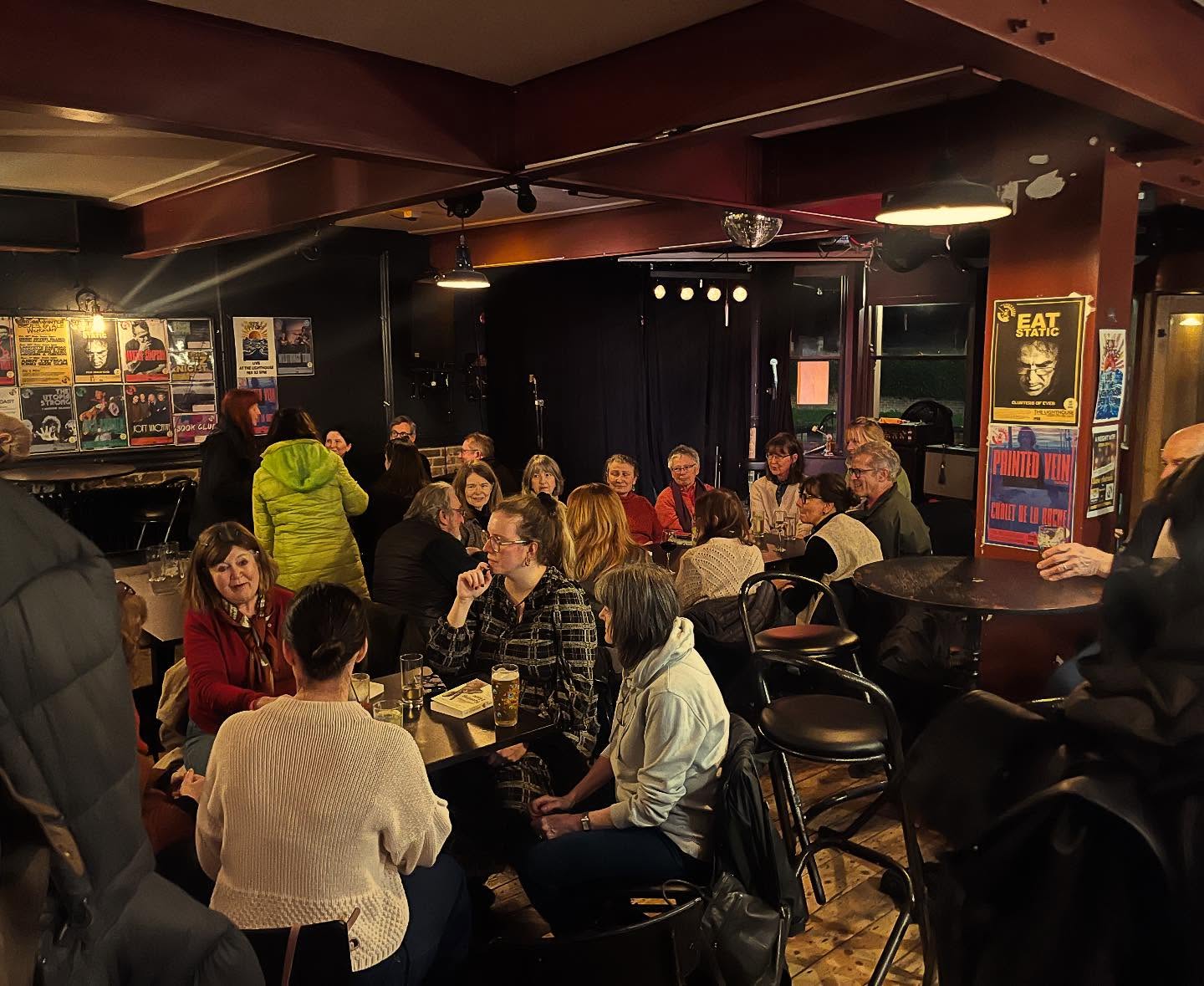
Around 30 members had another lively discussion about books at our September meeting and we welcomed some more new members. Thanks to everyone who came. Hope you had an enjoyable time and we will see you all next time (please note the earlier than usual start time).
This month we shared views on the classic ‘To Kill a Mockingbird’ by Harper Lee, Waterstone’s Book of 2025 ‘The Artist’ by Lucy Steeds, US modern fiction ‘Dream State’ by Eric Puchber and Ian McEwan’s latest ‘What We Can Know’.
The Bookclub is an informal community for anyone who enjoys a discussion on books over a drink with a wide group of friendly people.
If you want to join us just read one of the titles below (or more than one if you have time), come along and tell us what you think. We guarantee a warm welcome and some lively discussion.
The Lighthouse Bookclub
Our next meeting is Wednesday 11 November
Please note this meeting will start earlier than usual at 5.30 – 7.30pm (to accommodate the Open Mic night and you are very welcome to stay on)
This month's titles are:
● Classic: The Catcher in the Rye — J. D. Salinger Pages: 240 pages
Holden Caulfield leaves his prep school and spends several days moving around New York, resisting the adult world he sees as false and corrupt. His encounters with friends, teachers, strangers and his younger sister reveal a teenager struggling with grief, loneliness and the fear of growing up. The novel is less about a conventional plot than about the rhythm of Holden’s thoughts and his attempts to find genuine human connection. His fantasy of being a “catcher” who protects children from falling out of innocence captures his longing to preserve a world he is already losing. The story leaves the reader to consider how much of Holden’s alienation is rebellion, sadness, self-protection or all three.
Review: “He can understand an adolescent mind without displaying one.” — TIME
● Modern Fiction: In Memoriam — Alice Winn Pages: 400 pages
Set just before and during the First World War, the novel follows school friends Henry Gaunt and Sidney Ellwood as affection develops into a forbidden love. Their sheltered school world is shattered by enlistment and the brutal realities of the Western Front. The story moves between romance, military experience and the losses suffered by a generation. Winn explores how war changes ideas of masculinity, heroism, friendship and home. The novel combines the intimacy of a love story with the scale and horror of a historical catastrophe.
Review: “Even in the direst moments, Winn’s dialogue thrums with mirth and furious intelligence.” — The Guardian
● Modern Fiction: Buckeye — Patrick Ryan Pages: 480 pages
Buckeye follows two families in a small Midwestern town whose lives become intertwined across decades. A wartime secret, relationships, parenthood and changing ideas of respectability shape the lives of the characters. Ryan moves between generations to show how choices made in one era reverberate through the next. The novel examines love, grief, sexuality, forgiveness and the stories communities tell about themselves. Its broad historical sweep is matched by close attention to ordinary people and their private compromises.
Review: “Ryan’s characters are universally nuanced and finely wrought.” — The Guardian
● Modern Fiction: Vulture — Phoebe Greenwood Pages: 288 pages
Sara Byrne, an ambitious freelance journalist, travels to Gaza in 2012 hoping to establish herself as a war correspondent. Working from a hotel crowded with international journalists, she pursues increasingly dangerous stories and becomes entangled with people whose lives are directly shaped by the conflict. Her professional ambition gradually collides with the human cost of the stories she is trying to obtain. Greenwood explores the ethics, vanity and emotional pressures of journalism in a conflict zone. The result is a darkly comic novel that becomes increasingly disturbing as Sara’s confidence begins to fracture.
Review: “Vulture remains a remarkably skilful debut.” — The Guardian
● Factual: All the Beauty in the World — Patrick Bringley Pages: 240 pages
After the death of his brother, Patrick Bringley leaves his job at The New Yorker and becomes a guard at the Metropolitan Museum of Art. What begins as an escape from grief develops into a decade-long immersion in art, museum life and an unexpected community of colleagues. Bringley describes the galleries from an insider’s perspective, paying close attention to paintings, sculpture, architecture and the routines behind the public experience of a great museum. The book becomes a meditation on grief, friendship, work and the ways art can alter our understanding of ordinary life. It is both a memoir of loss and a celebration of the sustaining power of beauty.
Review: “What emerges is a beautiful tale about beauty.” — The Washington Post Book World